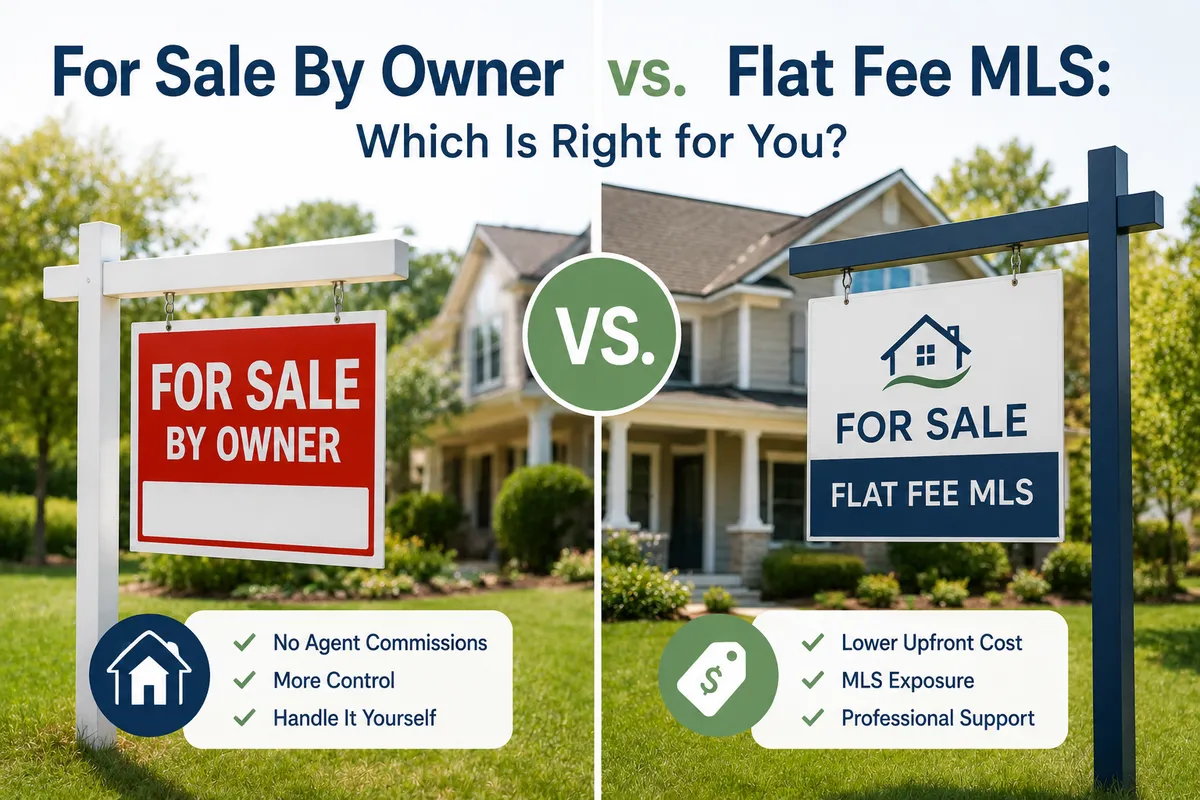
For Sale By Owner vs. Flat Fee MLS: Which Is Right for You?
For Sale By Owner vs. Flat Fee MLS: Which Is Right for You?
Selling your home without hiring a traditional real estate agent can help you save money, but it's important to understand the differences between a traditional For Sale By Owner (FSBO) sale and a flat fee MLS listing.
The short answer: a flat fee MLS listing gives you nearly everything a traditional For Sale By Owner (FSBO) sale offers — control over pricing, showings, and negotiations — while adding the one thing pure FSBO can't provide on its own: a listing on the Multiple Listing Service (MLS).
What FSBO Actually Means
A traditional FSBO sale means marketing and selling your home entirely on your own, without a licensed broker involved at any stage. You set the price, take your own photos, field buyer inquiries directly, and negotiate the sale yourself.
The tradeoff is exposure. Because only licensed brokers can submit a listing to the MLS, a pure FSBO listing generally isn't visible to the buyer's agents actively searching that database on behalf of their clients.
What a Flat Fee MLS Listing Adds
SaveEstate's Core Listing Package places your home on the MLS for a one-time flat fee starting at $595, with syndication to Zillow, Realtor.com, Trulia, Redfin, Homes.com, and other major sites.
You keep the parts of FSBO that save money and give you control:
You still decide your price.
You handle your own showings unless you add support services.
You negotiate directly with buyers.
The difference is that your listing now reaches agents and buyers searching the MLS, not just people who happen to find a yard sign or a FSBO website.
Where the Two Approaches Actually Differ
While both options allow you to remain in control of your home sale, there are several key differences.
MLS Access
A flat fee MLS listing gets your home on the MLS, while a pure FSBO listing typically does not.
Required Forms and Disclosures
With a flat fee MLS listing, a licensed brokerage assigns a managing broker to review your listing and required Illinois disclosures before it goes live. Pure FSBO sellers are fully on their own for this process.
Cost
A flat fee MLS listing requires a one-time fee. A pure FSBO sale has no listing fee at all, but it also doesn't provide MLS exposure.
Support
Flat fee sellers can add optional services such as showing management, marketing, and transaction coordination as needed. Pure FSBO sellers handle everything themselves by definition.
Which Fits You?
If your priority is maximum savings and you're comfortable handling every part of the sale yourself, pure FSBO is the most stripped-down option.
If you want that same level of control and cost savings but don't want to sacrifice MLS exposure—where the majority of serious buyers and their agents are actually searching—a flat fee listing is generally the stronger choice.
Final Thoughts
Both FSBO and flat fee MLS listings offer homeowners an alternative to paying a traditional listing commission. The primary difference comes down to exposure.
A traditional FSBO sale gives you complete control but limited visibility, while a flat fee MLS listing combines that same control with the added benefit of MLS exposure, helping your home reach more buyers and their agents.
For homeowners who want to maximize both savings and visibility, a flat fee MLS listing provides the advantages of selling on your own while expanding your property's reach.
Ready to get started? Contact SaveEstate or submit your request online at saveestate.com.